
Evaluating Machine Learning Models for Molecular Property Prediction: Performance and Robustness on Out-of-Distribution Data
Poster presentation at the 13th International Conference on Chemical Structures (ICCS) summarizing our systematic evaluation of 14 machine learning models across eight datasets and ten splitting strategies, examining how the choice of OOD generation procedure shapes both absolute performance and the strength of the ID–OOD correlation. See the associated publication.
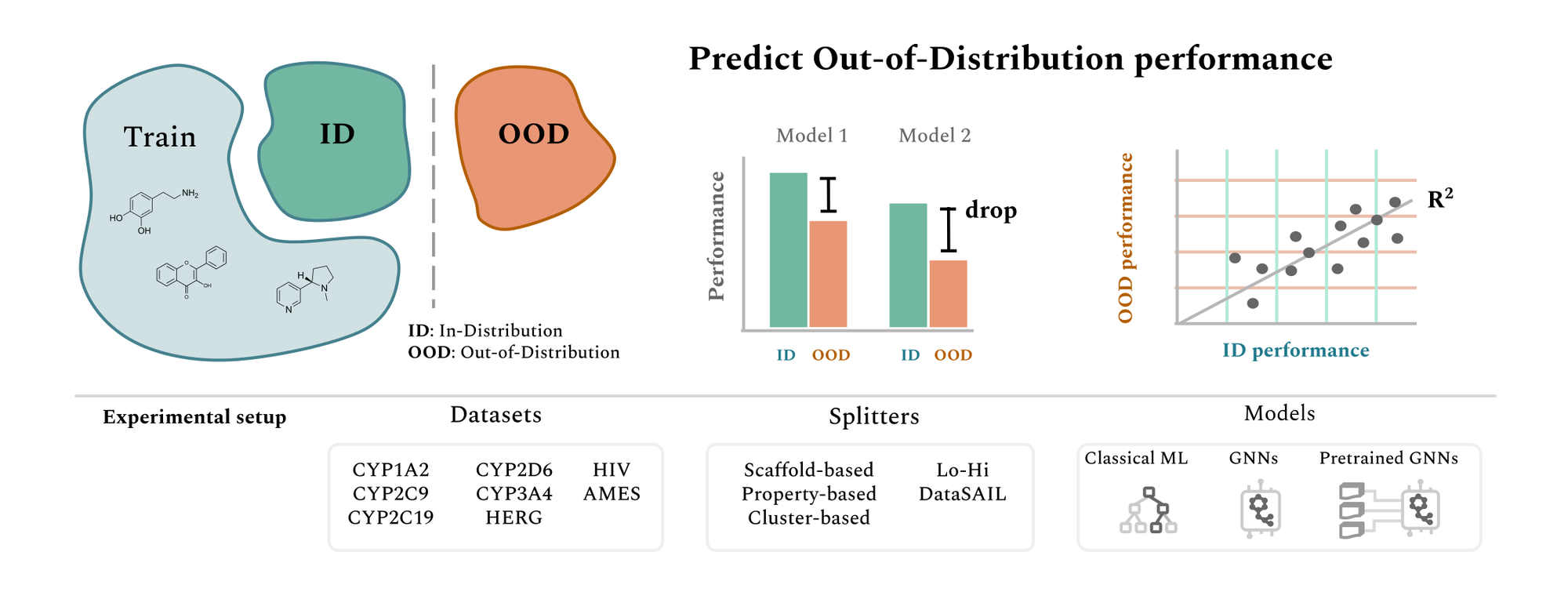
Headline result: both classical models and GNNs handle scaffold splits almost as well as random splits, while UMAP-cluster splits are the hardest. The correlation between ID and OOD performance is strong for scaffold splits (Pearson r ≈ 0.94) but drops to r ≈ 0.42 for cluster-based splits, so model selection on ID data is only safe when the split mirrors the intended application.
Authors: Hosein Fooladi, Thi Ngoc Lan Vu, and Johannes Kirchmair.