
System biology and waddington landscape
In this talk, I presented our work on pattern formation during human embryonic stem cell (hESC) development, the subject of my master’s thesis at Sharif. We proposed a multicellular mathematical model for pattern formation during the in-vitro gastrulation of human ESCs. This model enhances the basic principles of the Waddington epigenetic landscape with cell-cell communication, which enables us to describe how the pattern and tissue formation occurs in the course of development.
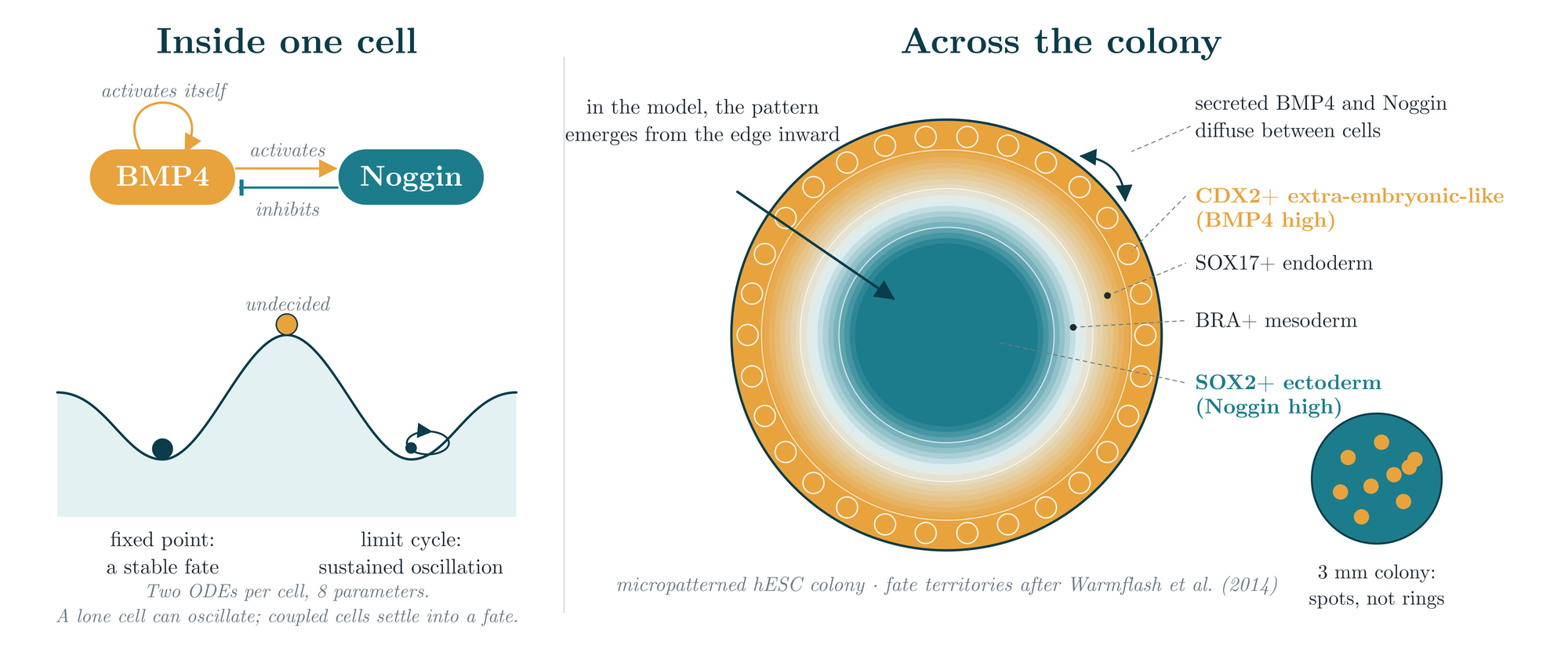
How the model works. Every cell carries the same minimal gene circuit: BMP4 activates itself and its own inhibitor Noggin, and Noggin inhibits BMP4. On its own, a single cell can oscillate indefinitely; once cells are coupled through diffusion of the secreted BMP4 and Noggin, they settle into stable fates. In a micropatterned colony the pattern is initiated at the boundary and spreads towards the centre, reproducing the concentric germ-layer rings seen experimentally. The same model also explains why very large colonies (around 3 mm) show spotted rather than ring-shaped territories, and how the pattern responds to altered culture conditions and micropattern diameters.
The work was published in Bioinformatics (2019), and the simulation code is on GitHub.
You can download the slides.